
Stoneledger Job Profit · for builders and contractors

Know what every construction job is really making.

Track costs, variations, CIS, retentions, profit and expected cash - all in one clear view. Beside Xero, QuickBooks, Sage or a spreadsheet, not instead of them.

Works from the receipts, bills and invoices you already have. It never asks for your accounting software's password.

Job 104 · a kitchen extension · made-up figures

Expected profit£5,269.4610.6% when the job is done
Cash so far-£12,836.04£18,832.50 in, £31,668.54 out

Why they are different

Click it. Each one opens to what it is about.

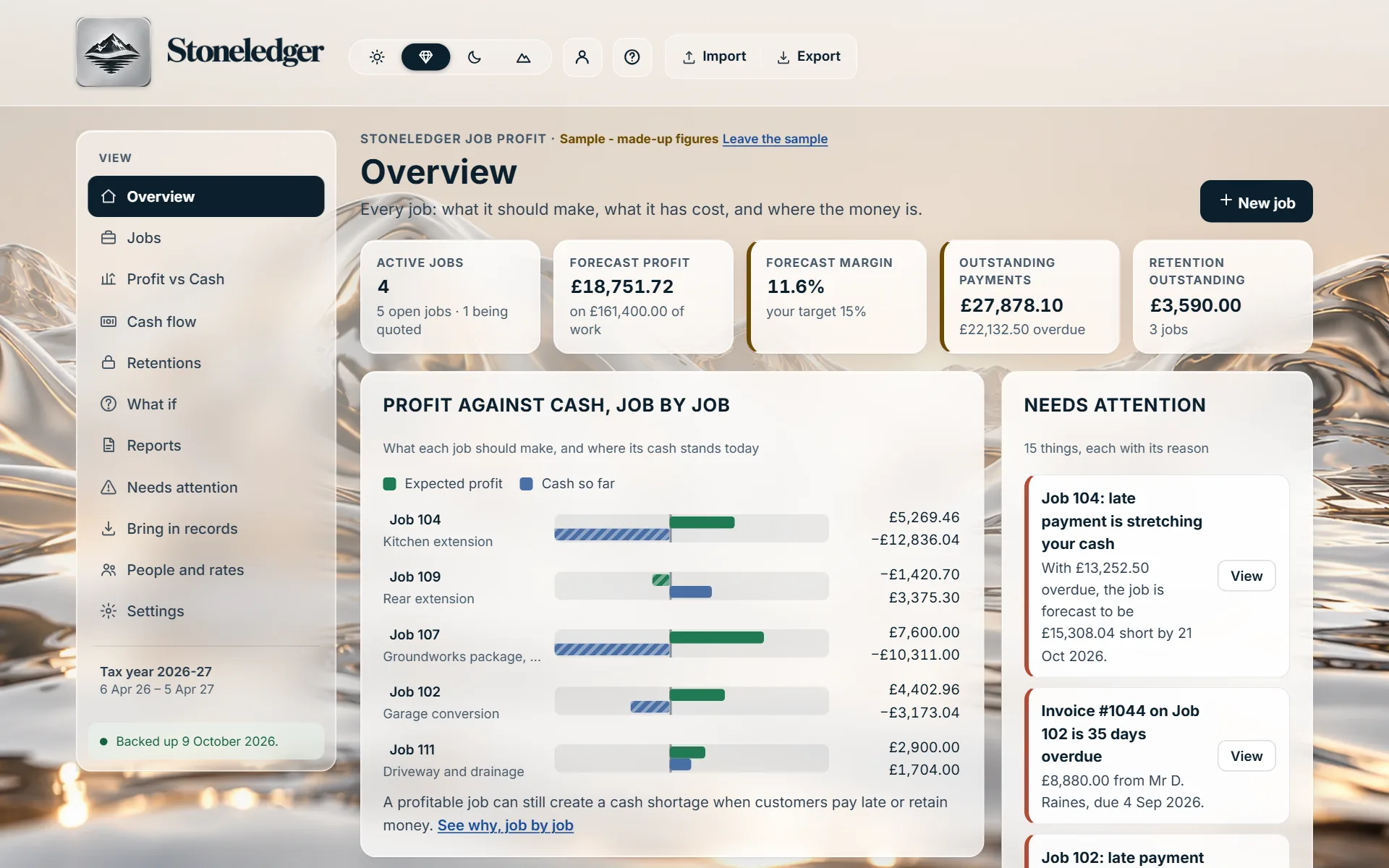
A sample kitchen extension, Job 104: it should make £5,269.46 profit, yet it is £12,836.04 out of pocket today - because a £13,252.50 invoice is overdue, £13,164.41 of work is not yet invoiced and £1,395.00 of retention is held, partly offset by £8,454.00 of bills not yet paid.

Why jobs surprise you

Your job looks profitable. But what happens after materials, labour, CIS and retention?

The price was right. The costs moved.

A steel beam upgraded at building control's request, a week more labour, a skip you did not plan for. Each is small; together they turn a 17% job into a 10% one - and you only find out when the last invoice is paid.

Profit is not cash

A customer paying late, retention held for months, the next stage not due for weeks: a job can make money on paper and still have you paying suppliers and wages out of your own account.

CIS and retention blur the picture

CIS taken off you is tax paid early, not a cost. CIS you take off a subcontractor is theirs, not a saving. Retention is money late, not money lost. Get any of them wrong and every figure after it is wrong too.

See inside

Job Profit, with a small building firm's seven jobs.

Click a screen to see it larger - or open the sample job yourself, on this device, with no account.

An example job · made-up figures

Job 104: a kitchen extension, priced at £46,500.

What it is worth

Job 104's revenue
The contract£46,500.00
Bi-fold doors, approved£3,200.00
Forecast final revenue£49,700.00
Quartz worktops, waiting for an answernot counted

The £1,850.00 variation still waiting is shown apart, with what approving it would do: £5,919.46 profit, 11.5%.

What it will cost

Job 104's costs
Spent so far - bills paid or not£36,710.54
Ordered, not yet billed£4,350.00
Still to spend to finish£3,370.00
Forecast final cost£44,430.54

Quoted at £8,050.00 profit (17.3%) on an estimate of £38,450.00. Now: £5,269.46, 10.6% - and every pound of the difference opens to the record behind it.

Profit vs Cash

A profitable job can still create a cash shortage.

Job 104 should make £5,269.46. Today it is £12,836.04 out of pocket. Job Profit says exactly why - every line is money that has not moved yet, or has moved early, and together they add up to the cash.

From the profit earned so far on Job 104 to its cash so far
Profit earned on the work done so far£4,353.87
Work done, not yet invoiced-£13,164.41
Invoiced, still to be paid to you-£13,252.50
Retention your customer is holding-£1,395.00
Bills you have not paid yet+£8,454.00
Retention you hold from subcontractors+£210.00
VAT not yet paid over+£1,958.00
Cash so far-£12,836.04
  • Lowest point ahead-£15,308.04, before the next stage is paid
  • If the customer pays 30 days late-£25,522.29 - £10,214.25 lower
  • When everything is paid£5,269.46 - the profit, once retention is back and VAT settled
  • On every jobExpected profit, cash in, cash out, cash to come, retention and CIS, side by side

Labour and materials

What the job really cost - not what the wages and the receipts say.

Labour at what it costs you

A bricklayer on £19.50 an hour costs the business more than that: employer's National Insurance, pension and holiday pay on top - £23.79 an hour in the sample. Job 104's 490 hours come to £10,320.54 against a £9,800.00 budget, and a pay rise never rewrites the hours already worked.

Materials, shared and returned

One merchant's bill split between two sites; padstones sent back for a credit; an order for the doors counted as committed until it is billed, then moved to spent - never both. Every part adds back to the bill it came from.

Still to spend, honestly

Let the budget say what is left, or put in what you know: £1,200 more labour, £640 of plastering sundries. The forecast is spent, plus ordered, plus still to spend - and the original estimate stays as it was.

CIS and retention

Worked out by Stoneledger's own CIS engine, on both sides.

Your subcontractors on Job 104

CIS taken off each subcontractor on Job 104
SubcontractorTheir costCISRetention held
Groundworks, verified - 20%£3,600.00£640.00-
Electrician, verified - 20%£2,500.00£351.50£125.00
Plumber, gross status - 0%£1,700.00£0.00£85.00

The job's cost is the whole £7,800.00. The CIS you take off is theirs, paid to HMRC for them - never a saving on the job. And it is taken on labour only, never on materials.

Retention, both ways

  • What your customers hold, stage by stage: at completion, after the defects period
  • What you hold from subcontractors, and when it is due back to them
  • Due soon, overdue, moved - and the cash forecast moves with it
  • CIS on a release at the status on the day it is paid, not the day it was held
  • Held money in the cash, never in the profit

On a job for a CIS contractor, Job Profit works the deduction on your invoices too - by payment, the way the statements are made up.

Variations and forecasting

Every change priced, and nothing counted until it is agreed.

  1. 1

    Record it as it is asked for

    What changes, what it adds to the price, what it adds to your costs. Draft, submitted, awaiting an answer, approved, rejected - each step kept.

  2. 2

    See what approving it does

    Pending variations are shown apart, never as revenue: "if it is approved, the job makes £5,919.46, 11.5%".

  3. 3

    Ask what if

    Materials up 10%, 40 more hours, retention three months late, the customer 30 days late: the profit and the cash, side by side - and your real records untouched.

On site

A receipt, an hour or a payment, in a few taps.

Job Profit is made for a phone first: the Add button is always there - something you spent, with a photo of the receipt; hours worked, for a day or the whole week; a payment from the customer; a variation as it is asked for. Then the job's profit and its cash, on the same screen.

Try it on your phone

Xero, QuickBooks, Sage and spreadsheets

Your software's own files today. Live connections are not built yet.

Job Profit reads the bills and invoices Xero, QuickBooks and Sage export, in CSV or Excel, and any spreadsheet with similar columns. A column naming the job - job, project, class, tracking or site - puts each line on its job; the same file brought in twice adds nothing, a line changed since is said and never applied, and a whole import can be undone.

It never writes anything back to your accounting software, and never asks for its password.

  • XeroNot connected to Xero: bring in the files Xero exports.
  • QuickBooksNot connected to QuickBooks: bring in the files QuickBooks exports.
  • SageNot connected to Sage: bring in the files Sage exports.
  • CSV and ExcelBuilt

Job Profit or Stoneledger

Keep your accounts where they are, or move everything.

Job Profit and Stoneledger, side by side
What you needJob ProfitStoneledger
Your accounting softwareKeep Xero, QuickBooks, Sage or a spreadsheetStoneledger is your accounting software
Job by job profit, budgets and forecastsYesJob references on its records
Profit against cash, retention, variations, what ifYesRetention on CIS invoices
CIS figures on both sidesYes, by the same engineYes, with statements and CIS300 returns
VAT returns, Self Assessment, Making Tax DigitalStay with your softwareYes
Price£10 a month or £80 a year£8 a month or £50 a year

Job Profit's records are Stoneledger's own - the same invoices, bills, payments and CIS - so your accountant can read them, and nothing is kept twice. Need CIS300 returns and statements as well? See the CIS Companion.

Pricing

Every job, one price. Round numbers, nothing added.

Monthly

£10 a month

Everything in Job Profit, for as many jobs as you run.

  • Cancel any time
  • Your jobs on any device you sign in on
  • No Stoneledger subscription needed
Start free

For the whole year

Yearly

£80 a year

A third less than paying monthly

The same, paid once for the year.

  • Reports for every job, whenever you want them
  • Your jobs on any device you sign in on
  • No Stoneledger subscription needed
Start free

Start with 30 days free, no card - choose monthly or yearly before it ends, or simply stop. No VAT to add: Stoneledger is not registered for VAT.

Questions

What builders ask first.

Do I have to stop using Xero, QuickBooks or Sage?

No. Job Profit works beside them: your accounts stay where they are, and Job Profit does the job costing - from the receipts, bills and invoices you put in on site, or the files your software exports.

Do I need Stoneledger's accounts as well?

No. Job Profit is sold on its own. Its records are Stoneledger's own kind, so if you ever move your whole books to Stoneledger, nothing has to be typed in twice.

Why is my job's cash so different from its profit?

Because money arrives later than it is earned and leaves before it is spent: stage payments not yet due, customers paying late, retention held back, CIS taken off. Profit vs Cash lists every one of those, job by job, and they add up to the difference.

Is CIS a cost on the job?

No. CIS taken off you is tax paid early, which comes back through your tax return. CIS you take off a subcontractor is theirs, paid to HMRC for them. Job Profit keeps both out of the job's costs and shows them in the cash.

Does it send anything to HMRC?

No. Job Profit works out the CIS on each job with Stoneledger's CIS engine; it does not send CIS300 returns. The CIS Companion and Stoneledger prepare those.

Does it connect to my Xero account?

Not yet. Today you export your bills or invoices and bring the file in. A live connection needs Stoneledger's own app registered with Xero, which has not been started; the same goes for QuickBooks and Sage.

Can my team use it on site?

Yes - it is made for a phone first. Costs, hours, payments and variations take a few taps, with a photo of the receipt.

What happens when the free trial ends?

Choose monthly or yearly to carry on, with every job kept. No card is asked for at the start, so if you do nothing, nothing is charged.

Is this accounting or tax advice?

No. Job Profit applies the rules to the records you put in and shows how every figure is worked out, so you and your accountant can check it.

Know what your next job is really making - before the last invoice.

Open the sample job in a minute, or start with your own. 30 days free, no card.

Xero, QuickBooks and Sage are trademarks of their owners. Stoneledger is independent and not affiliated with, endorsed by or a partner of any of them; Job Profit reads the files they let you export.

Register interest

Be first when Stoneledger opens.

Tell us a little about your lettings and we’ll let you know as soon as it’s ready for you. Fields marked * are required.

Business type *

Book a demo

See Stoneledger on a book like yours.

Leave your details and a time that suits you, and we’ll be in touch to confirm it. Fields marked * are required.