
Deemed contractors

When CIS applies to a business that does not build.

A business that does not do construction work still becomes a contractor under the Construction Industry Scheme (CIS) once it has spent more than £3 million on construction in the 12 months since its first payment. From then on it registers, verifies, deducts, gives statements and files a return every month, like any contractor. Here is the test, and what does not count, from HMRC's own guidance.

The test

More than £3 million in 12 months.

Mainstream or deemed

A mainstream contractor's business is construction, and it pays subcontractors for construction work. A deemed contractor's business is something else, but it has spent more than £3 million on construction in the 12 months since it made its first payment.

Who HMRC names

GOV.UK's examples are housing associations, arm's length management organisations (ALMOs), local authorities and government departments. The test is the spending, though, so it reaches any business that passes it.

Once you are in

Register as a contractor, through PAYE. Then verify each new subcontractor, take the right deduction off their labour, give them a statement within 14 days of each tax month, pay HMRC by the 22nd and send a return by the 19th.

What does not count

Your own premises, small contracts, and work outside CIS.

Your own business use

CIS does not apply to a deemed contractor's work on property for its own business use - property that is not for sale or rent.

Contracts under £1,000

A construction contract worth less than £1,000, not counting materials, can be exempt - but only once you have called the CIS helpline and HMRC has agreed it.

Not construction at all

Architecture and surveying, scaffolding hire with no labour, carpet fitting, delivering materials, and work on site that is not construction, such as running the canteen, are outside the scheme.

The months you pay nobody

Tell HMRC either way.

A nil return, or an inactivity request

In a month with no payments to subcontractors, send a return showing nothing paid, or tell HMRC you have stopped using subcontractors for now. An inactivity request lasts up to six months and can be renewed; a return with payments on it ends it.

A longer quiet spell

A deemed contractor whose construction spending comes and goes can ask HMRC for an inactivity period longer than the usual six months.

HMRC sets it out in who is covered by CIS and telling HMRC about changes.

What Stoneledger does

The contractor side of CIS, the same for you as for a builder.

  • Subcontractors on file with their UTR, verification number and rate, and anything a return needs flagged before the month closes.
  • The deduction on every subcontractor's bill, on the labour only, at the rate HMRC gave you.
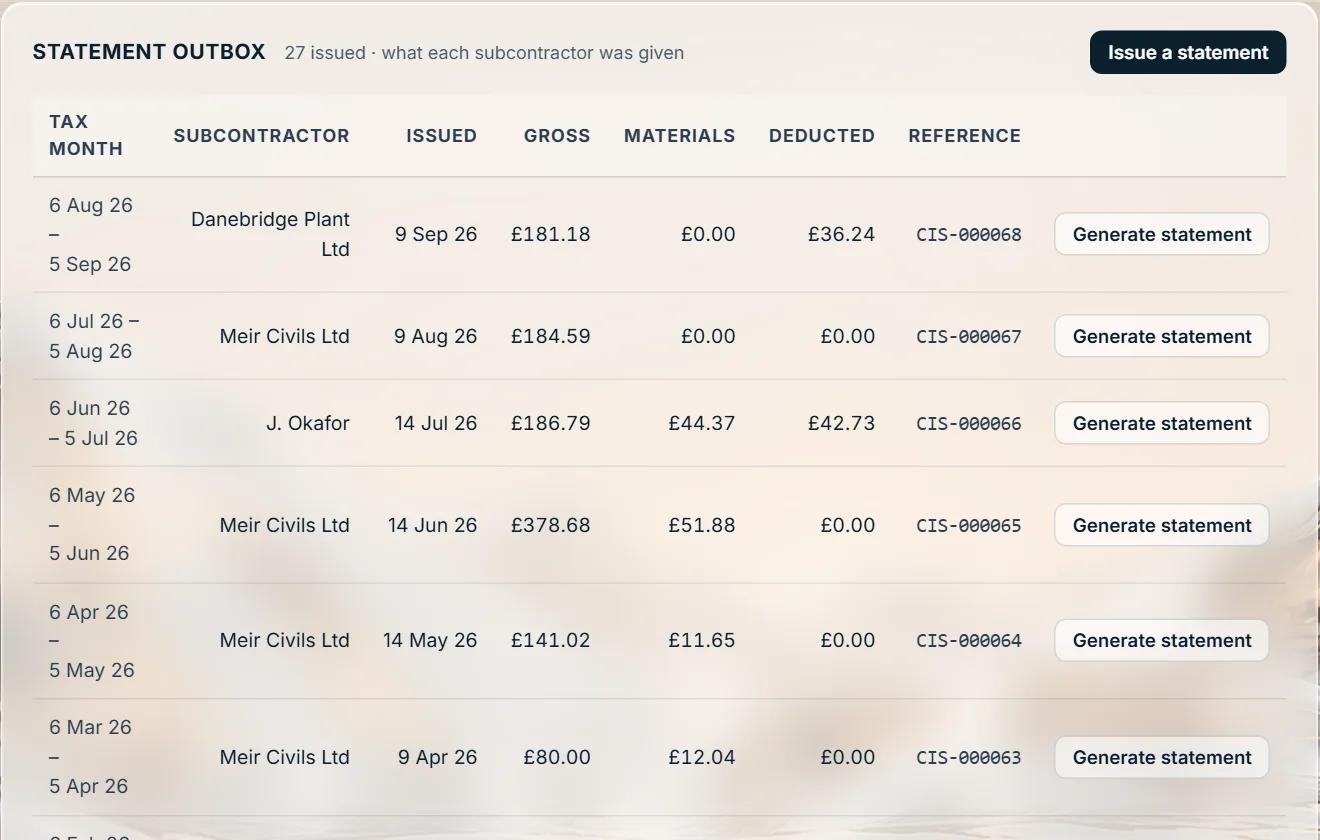
  • A statement for every subcontractor, prepared for each tax month.
  • Every tax month's CIS300 with its due date, nil returns included, and the penalty clock running until a return has really gone.
The statement outbox: every payment and deduction statement issued, with its tax month, the subcontractor, the date it was issued, the gross paid, materials, the amount deducted and its reference
Monthly statements to every subcontractor · Sole trader sample book

The contractor side of CIS, every month.

Verified, deducted at the right rate, with every statement and return kept together.

Register interest

Be first when Stoneledger opens.

Tell us a little about your business and we’ll let you know as soon as it’s ready for you. Fields marked * are required.

Business type *

Book a demo

See Stoneledger on a book like yours.

Leave your details and a time that suits you, and we’ll be in touch to confirm it. Fields marked * are required.