The Annual Investment Allowance
Up to £1 million a year of most plant and machinery comes off your profit in full, in the year you buy it. It is not available on cars.

Fixed assets and capital allowances
A van, tools, machinery or a computer is a fixed asset: the business keeps it and uses it for years. How you get tax relief on it depends on how you keep your books. On the cash basis, now the default for sole traders, most equipment is simply an expense; otherwise, and always for a company, it is relieved through capital allowances. Here is how they work, and what Stoneledger does about it.
Capital allowances
Up to £1 million a year of most plant and machinery comes off your profit in full, in the year you buy it. It is not available on cars.
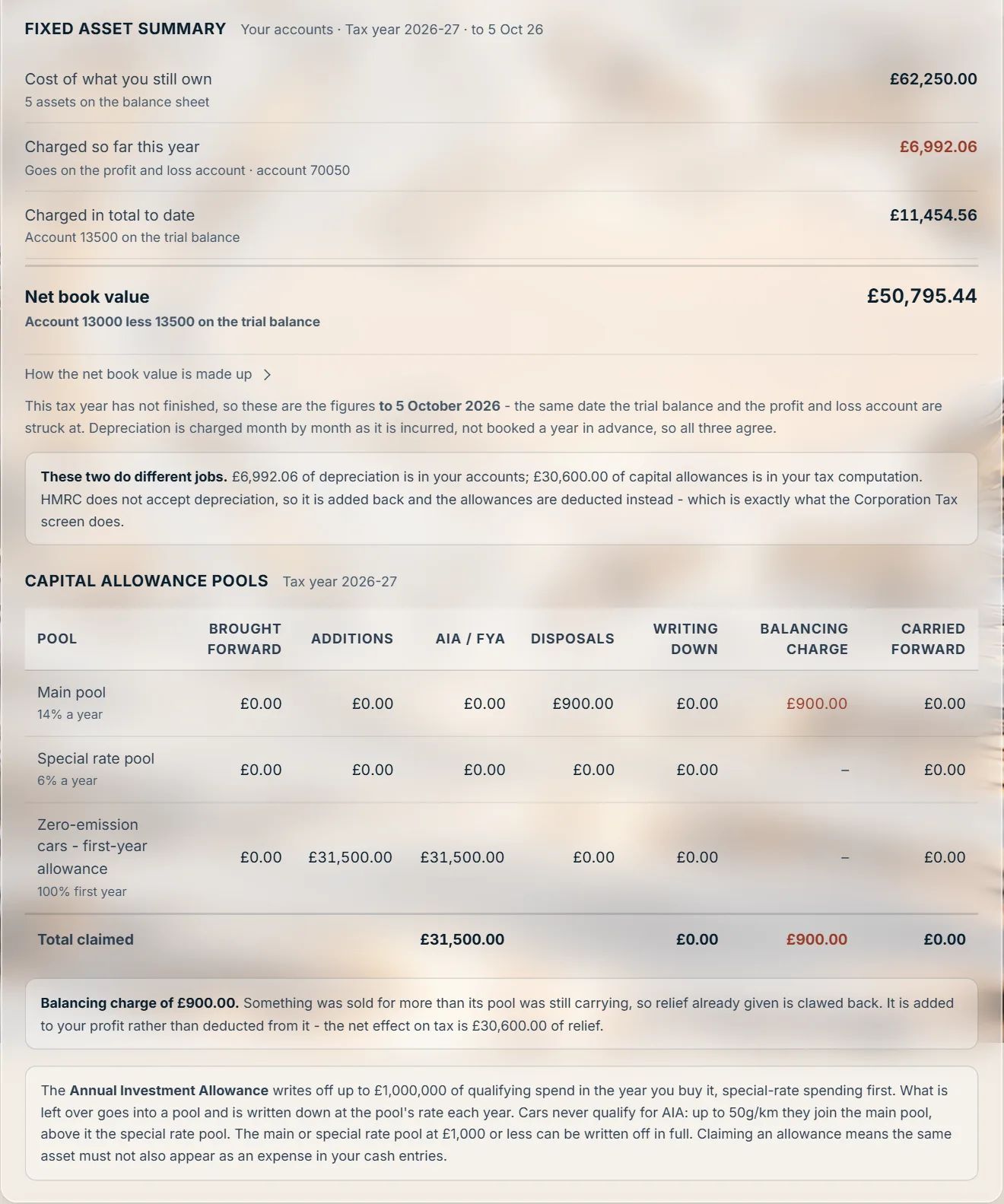
Whatever is not covered goes into a pool and is relieved a share at a time: 14% a year for most things from April 2026, 18% before, and 6% for the special rate pool. A pool of £1,000 or less can be claimed in full.
A new electric or zero-emission car bought before April 2027 can be claimed in full in its first year. Other cars go in the main or special rate pool, depending on their CO2 emissions.
HMRC sets it all out in its guide to claiming capital allowances, including the 40% first-year allowance on main rate items bought from 1 January 2026.
What changes it
The cash basis has been the default for sole traders and partnerships since 6 April 2024. On it, equipment you buy to keep is an ordinary business expense, and capital allowances are claimed on business cars only.
Use something outside the business as well, and you claim only the business share. A £600 laptop used half the time privately has its allowance cut by half.
When you sell, give away or stop using something you claimed on, its value goes back into the calculation for that year. If you had claimed it in full and the pool has nothing left, the value is added to your profit: a balancing charge.
HMRC’s own pages: the cash basis and capital allowances when you sell an asset.
What Stoneledger does
What it costs
One plan, with everything in it: the books, fixed assets, your Self Assessment or Corporation Tax, VAT, CIS, payroll and journals. No tiers to climb and no add-ons. 30 days free, no card needed. How that compares
Stoneledger keeps what the business owns with the allowances worked out year by year, and every number opens onto the working behind it.