What counts
Your self-employed income and any rent, added together, before any costs. HMRC calls this your qualifying income. A job, a pension, dividends and your share of a partnership’s profit do not count towards it.

Making Tax Digital for Income Tax
If your self-employed income, together with any rent, came to more than £50,000 before costs in the 2024 to 2025 tax year, Making Tax Digital (MTD) for Income Tax has applied to you since 6 April 2026. More than £30,000 in 2025 to 2026 brings you in from 6 April 2027, and more than £20,000 in 2026 to 2027 from 6 April 2028. Here is what it asks of you, and what happens if you are late.
Are you in?
Your self-employed income and any rent, added together, before any costs. HMRC calls this your qualifying income. A job, a pension, dividends and your share of a partnership’s profit do not count towards it.
HMRC looks at a tax return from before you start: 2024 to 2025 for April 2026, 2025 to 2026 for April 2027, and 2026 to 2027 for April 2028. HMRC writes to tell you, but you have to check for yourself even if no letter comes.
In your first year as a sole trader, HMRC scales your income up to a full year: six months’ trading counts twice over.
Not sure? The free MTD checker works it out from your answers, and HMRC explains it in its guide to qualifying income.
What it asks of you
Each sale and each cost, with its date, its amount and its category: the same categories as Self Assessment. While your turnover is under £90,000 you can simply record each one as income or an expense.
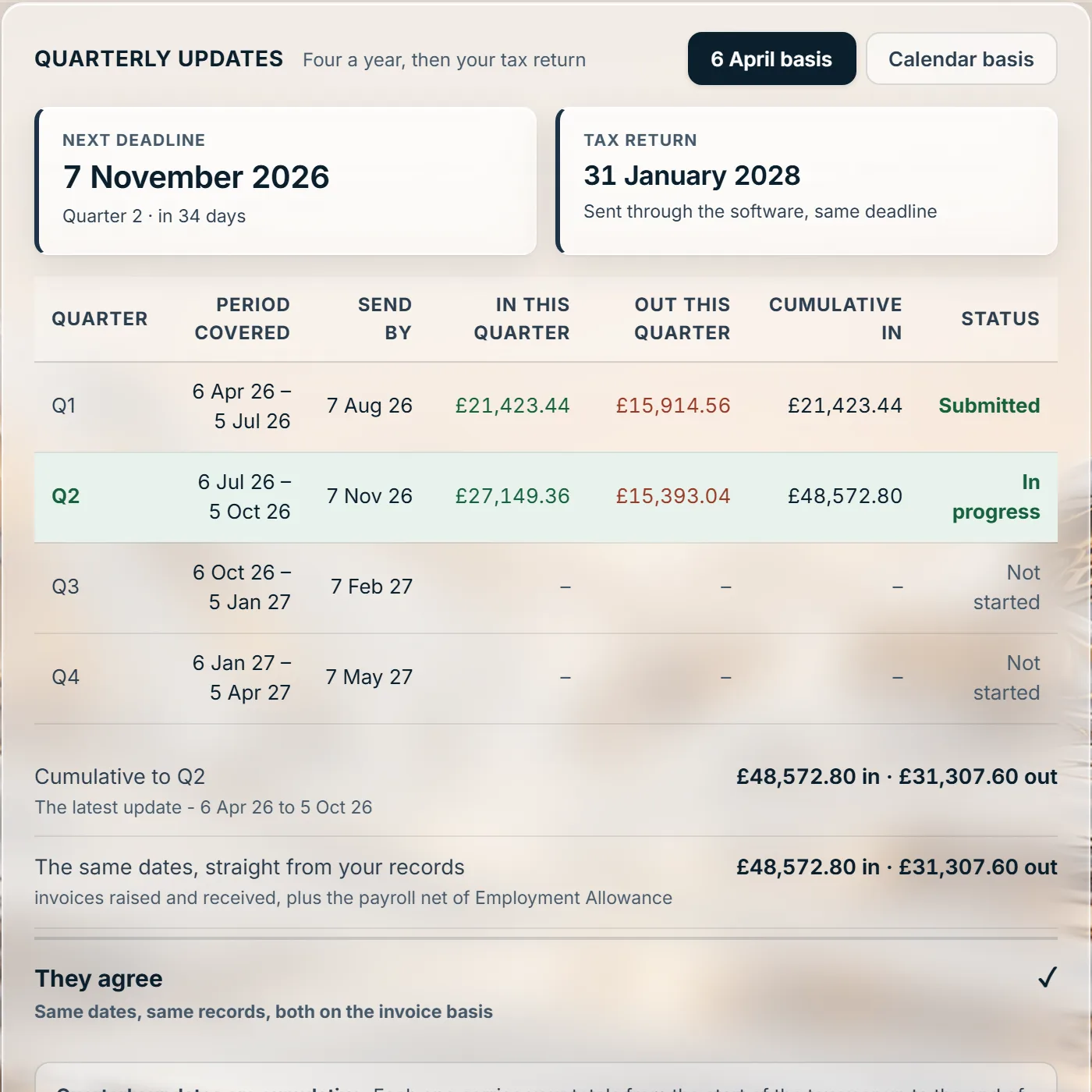
The year so far, due by 7 August, 7 November, 7 February and 7 May. They are summaries, not tax returns, and no tax is paid with them. If nothing came in or went out, you still send one.
By 31 January after the tax year, as now, but sent through software. HMRC adds what it already holds, such as a job, a pension or CIS deductions, for you to check before it goes.
Keep the records for at least five years after the 31 January deadline, as you do now for Self Assessment.
If you are late
HMRC is not giving penalty points for late quarterly updates in the 2026 to 2027 tax year, whenever you joined. The updates still have to be sent before your tax return can be, and a late tax return still earns a point.
Each missed update or tax return deadline is a penalty point. At four points you pay £200, and £200 again for each deadline you miss after that.
Below four, each point goes 24 months after the deadline it was for. At four, they all go once you have been on time for 12 months and sent anything still outstanding.
Paying late has penalties of its own, which grow the longer the tax is outstanding. HMRC sets them all out in its guide to the penalties.
What Stoneledger does
What it costs
One plan, with everything in it: the books, Making Tax Digital, VAT, CIS, payroll, property and journals. No tiers to climb and no add-ons. 30 days free, no card needed. How that compares
Stoneledger keeps your records, works out each update and your tax as you go, and shows where every number came from. It has completed its testing in HMRC’s sandbox, and sending your updates is on track for the 2027 to 2028 tax year.